Quick Answer
A marketing audit before hiring is a review of your current marketing, including positioning, channels, funnel, and data. This is done before you bring on any new person or agency. It tells you whether your problem is a people problem or a system problem, so you hire for the right role instead of paying someone to fix issues a new hire can’t solve alone.
Sales are flat, leads have gone quiet. So, you do the obvious thing and decide to hire. Maybe a marketing manager, an agency, or your first real marketing person after years of running it yourself. But most founders learn the hard way, usually six months and a full salary later, that the new hire inherited the same broken system. The same unclear positioning, the same leaky funnel. You didn’t fix the problem, you just put a more expensive person in front of it.
The step everyone skips is figuring out what’s actually broken before you pay someone to fix it. That step is a marketing audit.
7 Reasons Why you need a marketing audit before hiring
A marketing audit is not something that you run every six months or before Q4. This is about one specific moment: the point where you’ve already decided to hire. That’s when a marketing audit matters most and gets skipped the most, because hiring feels like progress and an audit feels like a delay. But hiring into a problem you haven’t diagnosed yet can further make the situation a costlier version of the same confusion. Here are seven reasons why you should audit before you hire.
1. You’ll hire for the wrong role
Without an audit, you’re just guessing at the job description. You bring on a content person when the problem is lead tracking. You hire a performance marketer when the actual problem is that nobody understands what you sell.
Take a services firm that hired a social media manager to lift visibility. Engagement jumped but leads didn’t move. The bottleneck was a website that never explained the offer clearly, and no amount of posting was going to fix that.
2. You can’t brief anyone properly
A new hire is only as good as the brief you hand them. If you can’t say which channel brings your best leads, or where prospects go cold, they’ll burn their first quarter rediscovering what you should already know.
One manufacturing business brought in an agency with no baseline data at all. The first three months, all billed, went to discovery the founder could have handed over on day one.
3. You’ll have no way to measure them
If you don’t know your numbers before someone starts, you can’t tell whether they changed anything. Performance becomes a matter of opinion, and opinion is a terrible way to manage a salary. An audit sets the baseline that makes accountability possible later.
4. You might not need the hire at all
Sometimes the audit shows the fix is a positioning rewrite or a repaired funnel, not a new salary. One founder planning to hire two marketers discovered the real issue was a leaking enquiry form. Fixing it recovered more revenue than either hire would have.
Wondering what a marketing audit would look like for your business?
Book a free 30-minute call with Maran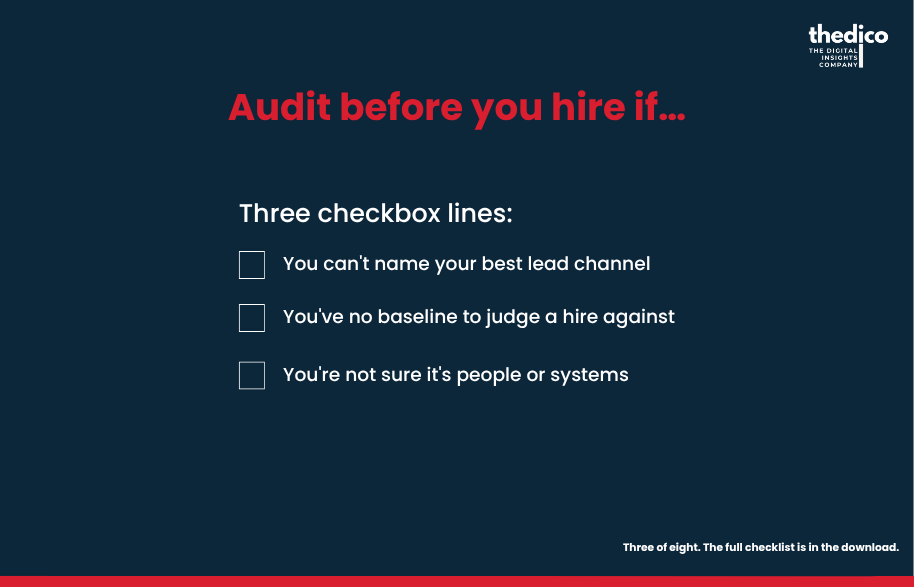
5. You’ll onboard faster and cheaper
An audit doubles as an onboarding document. Whoever you bring on, internal or agency, starts with a map instead of a blank page. The weeks usually lost to ramp-up shrink to days, because the hard thinking is already done.
6. You’ll spot problems no hire can fix
Some issues aren’t marketing problems at all. Unclear pricing, a weak offer. A sales and marketing team that don’t talk. No hire fixes those, and hiring one to try just moves the frustration around. An audit shows them clearly before you blame the wrong person for the wrong thing.
7. A bad hire is expensive
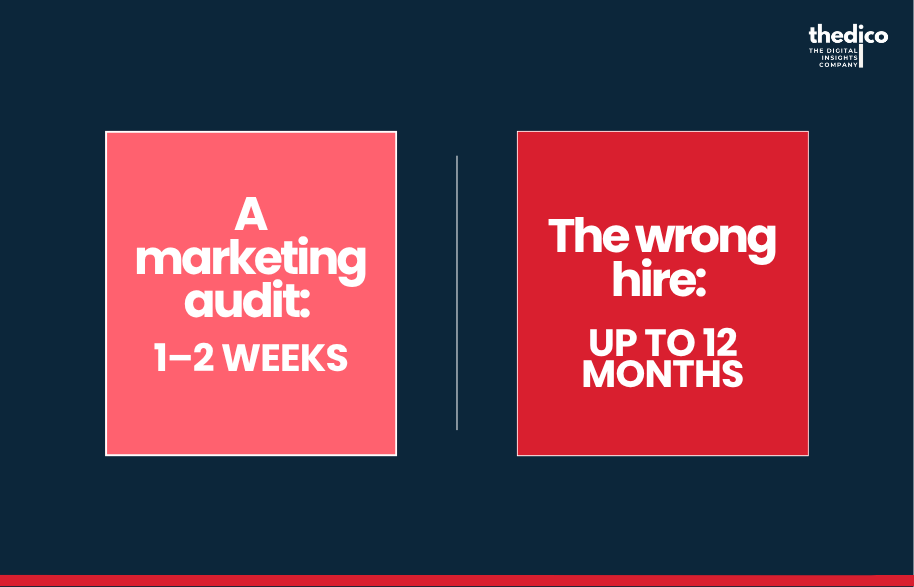
The cost of the wrong hire isn’t just the salary. It’s the months lost before you admit it isn’t working, the severance or contract exit, and the rehiring that starts the clock all over again. For a small business, one wrong marketing hire can quietly swallow a year.
The numbers are steep. The U.S. Department of Labor puts the cost of a bad hire at a minimum of 30% of their first-year salary, and that’s the floor. For a mid-level marketing role, once you add lost time and productivity, it climbs past 100% of salary. For a small business, one wrong hire can quietly swallow a year.
An audit is the cheapest insurance against that. A week or two of diagnosis up front is a rounding error next to twelve months spent paying for the wrong decision.
Most founders don’t hire the wrong person. They hire the right person for a problem they never actually diagnosed.
What good looks like
Done right, the order is simple. Audit first. Decide second. Hire third. You walk into the decision knowing the exact role you need, the baseline to judge it against, and the problems no hire can solve. At TheDIco, that’s the front end of every engagement: a structured marketing audit that turns a vague “we need help” into a clear brief. The hire that follows actually has a chance of working.
Signs you need a marketing audit before hiring
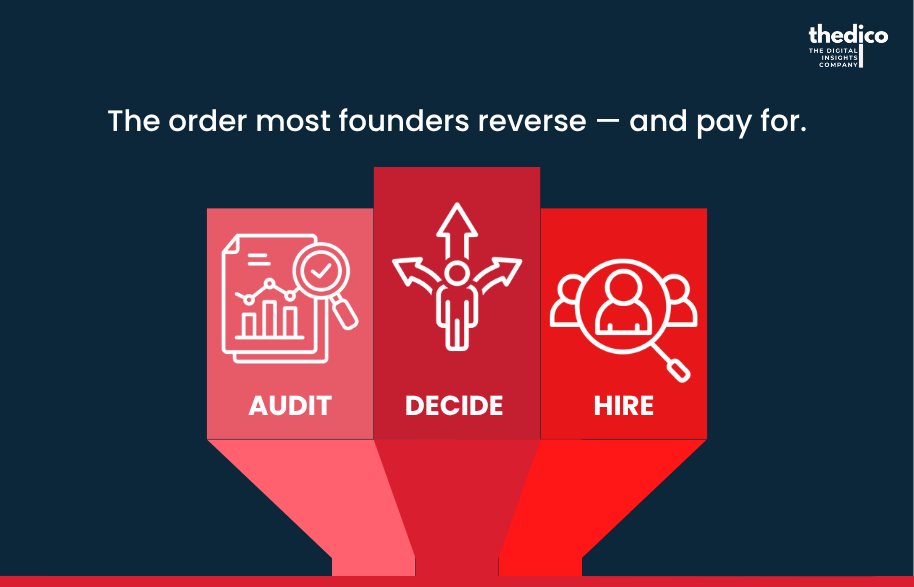
We built a free pre-hiring checklist so you can pressure-test your own marketing before you write a single job description. If any of these sound familiar, audit before you hire:
- You can’t name which channel brings your best leads.
- You have no baseline numbers to judge a new hire against.
- You’re not sure whether the problem is people or systems.
The full checklist runs to eight questions covering positioning, channels, measurement, ownership, and strategic alignment — the same ones we ask at the start of every engagement. Work through it in about twenty minutes. If you come out the other side wanting a second set of eyes, that’s exactly what we’re here for. Every TheDIco engagement starts with an honest look at where you are today and a clear view of what your business actually needs next.
Wondering what your audit would actually uncover?
Before you write a job description or sign an agency contract, it’s worth knowing what’s really broken. That’s the honest starting point, and it usually costs a great deal less than the wrong hire.
Frequently asked questions
What does a marketing audit include?
A marketing audit reviews your positioning, channels, website, funnel and data to show what’s working and what’s leaking. It maps where leads come from, where they drop off, and whether your spend matches your results. At TheDIco, the audit results in a prioritised list of fixes and a clear view of your next step.
How long does a marketing audit take?
An audit usually takes one to three weeks, depending on how much data exists. A small business with one or two channels can be reviewed quickly. A company with paid media, a sales team and several funnels takes longer. Maran’s approach favours speed to clarity: enough depth to make a confident hiring decision, without dragging it into a months-long project.
Should I audit my marketing before hiring an agency?
Yes. An audit before signing an agency stops you paying discovery fees for information you could hand over on day one. It also tells you whether an agency is even the right move. TheDIco often finds the real fix is internal, a positioning or funnel issue that a new agency can’t solve on its own.
How is a marketing audit different from a marketing strategy?
Marketing audit vs marketing strategy: an audit diagnoses, a strategy prescribes. The audit tells you what’s actually happening, what’s working, what’s broken, what’s leaking. The strategy is the plan you build on top of those findings. Maran treats the audit as the foundation: you can’t plan a route without first knowing where you’re standing.
Can a fractional CMO run a marketing audit?
Yes, a fractional CMO brings senior-level experience without a full-time salary, which makes them well-suited to run the audit and read what it’s telling you. They can say whether you need a hire at all, and if you do, which role. That’s the model Maran works in: diagnose first, then decide what the business actually needs.
Filed under
- Marketing audit
- Hiring
- Fractional CMO