Quick Answer
Your B2B marketing is working when leads can tell you how they found you, your pipeline contains new names beyond your referral network, your sales team uses what marketing produces, and you can connect at least some spend to a real conversation. If none of these are true, your marketing is just running but it is not working. The fix starts with measuring the right four numbers, not forty.
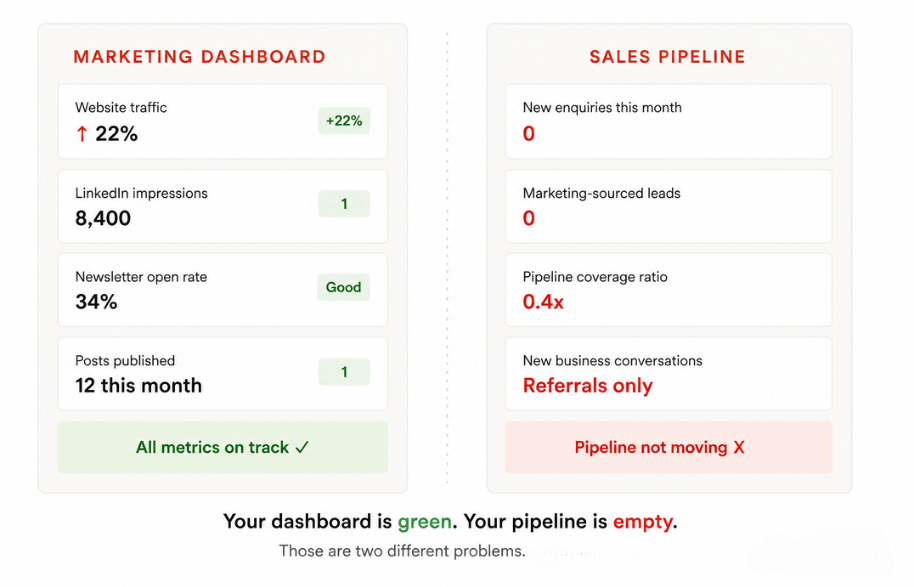
Rajan runs a 45-person IT services company in Coimbatore. Every Monday, his marketing executive sends a report. Website traffic is up 22 per cent. LinkedIn impressions crossed 8,000 last month. Three posts went out. The newsletter open rate is sitting at 34 per cent. By every number on that dashboard, marketing is doing its job.
But Rajan's pipeline hasn't changed in three months. Same five prospects. Two of them referrals from 2023. The new business conversations he expected haven't come. When he asked his sales head where last month's enquiries came from, the answer was the same as always – word of mouth, one old contact, an exhibition follow-up from six months ago.
The dashboard says green. The pipeline says something else entirely. This is not a marketing execution problem but more of a measurement problem, and the two are not the same thing. If you are trying to know whether your marketing is working, the gap between activity and pipeline is exactly where the answer lies.
Here is how to diagnose it.
The 4 Marketing Missteps That Hide the Problem
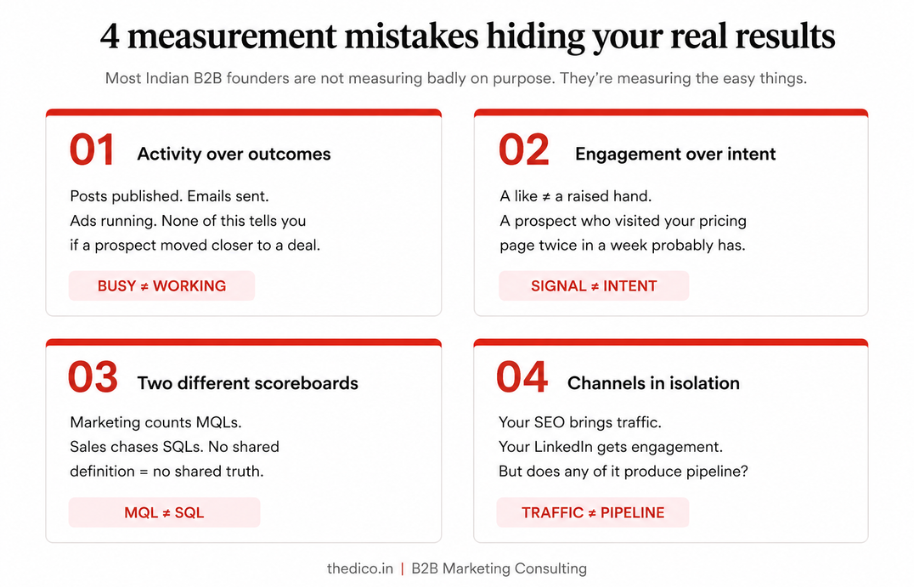
Before we get to what working marketing looks like, it helps to name what broken measurement looks like. Most B2B founders are not measuring badly on purpose. They are measuring the wrong things because those are the numbers that are easy to find.
- Tracking activity instead of outcomes. Posts published, emails sent, and ads running do not tell you whether a prospect moved closer to a conversation.
- Confusing engagement with intent. A prospect who liked your LinkedIn post has not raised their hand. A prospect who visited your pricing page twice in a week probably has.
- Letting marketing and sales measure different things. Marketing reports MQLs (Marketing Qualified Leads). Sales chases SQLs (Sales Qualified Leads). Without an agreed-upon definition connecting the two, both teams work from different scoreboards.
- Measuring channels in isolation. Knowing that your SEO brings traffic or your LinkedIn gets engagement is not useful unless that traffic or engagement turns into qualified pipeline opportunities.
The result is what most Indian B2B founders describe as a black box: money and effort going in, activity coming out, and no way to know whether any of it is generating revenue.
How to Measure Marketing Strategy Effectiveness: Start With the Right Question
Most posts on this topic tell you to define your KPIs, set up dashboards, and track your CAC (Customer Acquisition Cost — the total spend required to acquire one new customer). That advice is not wrong. It is just the wrong starting point for a founder who does not yet have a data team, a CRM in use, or a clear baseline.
The right starting question is not 'what should I track?' It is 'what is my pipeline actually telling me?' Your pipeline is the one number that cannot be faked. It does not care about impressions or open rates. It reflects whether real business conversations are happening — and whether marketing had anything to do with starting them.
Your Leads Can Tell You How They Found You
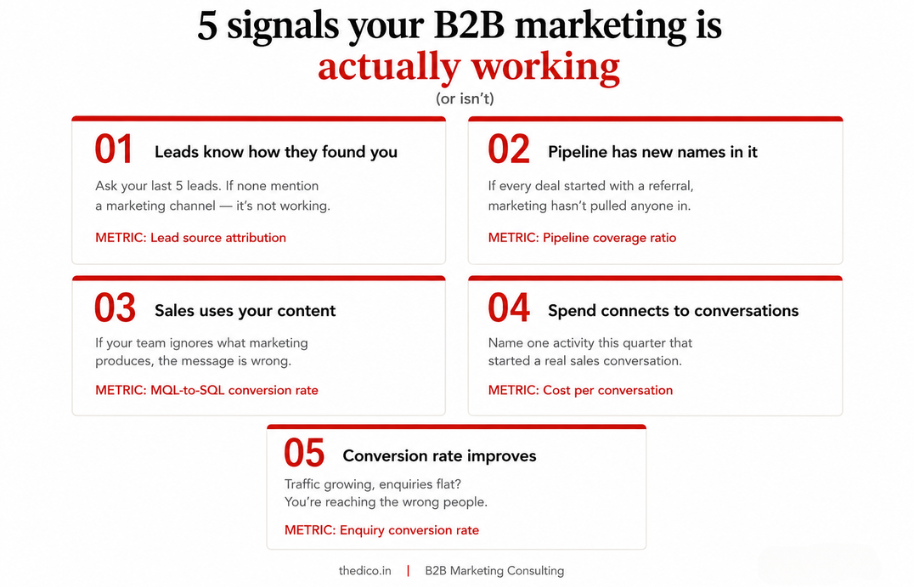
This is the simplest and most overlooked diagnostic question in B2B marketing. The next time a new lead gets on a call with your sales team, ask: 'How did you hear about us?' If the honest answer is always 'referral from X' or 'we met at an event,' your marketing has no pull. It is not bringing anyone new into the room.
When marketing is working, at least some leads trace a path back to a channel. Someone read a blog post and reached out. Someone searched a specific problem and found you. These paths do not need to be automated or perfect — but at least some of them should exist. Zero marketing-sourced leads in six months is a clear signal.
Healthy: 20–30 per cent of new leads name a marketing channel unprompted. Broken: Every single lead is a referral or a personal introduction.
REAL-WORLD EXAMPLE
An IT services company in Bangalore started asking 'how did you hear about us?' in every first sales call and logging the answer in a simple spreadsheet. For four months: 100 per cent referrals. In month five, after publishing three problem-led blogs, two leads mentioned finding them via Google. A small number — but it confirmed a channel was starting to work, and it told them exactly where to invest next.
METRIC TO TRACK: Lead Source Attribution — Track where every enquiry comes from. A single column in a spreadsheet labelled 'How did you find us?' is enough to start. No CRM required.
Your Pipeline Has New Names in It — Not Just Old Contacts
Referrals are valuable. They are also a warning sign when they are your only source of new business. A referral-dependent pipeline means your growth is capped by the personal network of your founder and senior team. When that network quietens — and it always does — your pipeline quietens with it.
Marketing that works introduces your business to people who have never heard of you before. Not hundreds of them. Even five to ten new, genuinely qualified prospects per quarter from a marketing channel is a meaningful signal. The question to ask honestly: when was the last time a deal started with someone who had no prior connection to your business?
Healthy: At least 20 percent of pipeline opportunities originate from a marketing channel. Broken: Every deal in the last 12 months started with a referral or a cold outreach from the founder.
REAL-WORLD EXAMPLE
An HR consultancy in Bengaluru mapped every deal closed in the past two years. The result: 94 per cent came through personal introductions. The founder's network was strong. But when she stepped back from business development for three months, the pipeline halved. Marketing had never been built to compensate for that dependency, and the business had no way to grow beyond one person's reach.
METRIC TO TRACK: Pipeline Coverage Ratio — Total value of active pipeline opportunities divided by your monthly revenue target. A healthy B2B pipeline runs at 3x or more. Below 2x is a warning. Below 1x is a crisis.
Your Sales Team Uses What Marketing Produces
Ask your sales team one question: 'Which marketing content do you share with prospects?' If the answer is 'nothing' — or if they have built their own pitch decks because marketing's materials don't work for them — that is a direct signal of sales-marketing misalignment. And misalignment is not a relationship problem, but more of a measurement problem.
When marketing and sales are aligned, MQLs (Marketing Qualified Leads — prospects who have engaged with marketing content and meet basic ICP criteria) convert into SQLs (Sales Qualified Leads — prospects that sales has verified are ready for a conversation) at a predictable rate. When they are not aligned, marketing generates activity and sales generates pipeline, and neither team can explain the gap between the two.
Healthy: Sales references marketing content in at least 30 per cent of active deals. Broken: Sales consistently describes leads as 'low quality' or 'not ready' — or never uses marketing materials at all.
REAL-WORLD EXAMPLE
A B2B kitchen equipment manufacturer had a full set of brochures, a product catalogue, and a company profile, all produced by marketing. Their sales team's honest feedback: 'We don't use any of it. Clients ask about ROI and lead times, not product features.' The content existed. It answered the wrong questions entirely. Marketing was measuring content output. Sales needed content that answered buyer objections.
METRIC TO TRACK: MQL-to-SQL Conversion Rate — (Number of leads that sales accepts as qualified ÷ total MQLs passed to sales) × 100. A rate below 20 per cent usually signals messaging misalignment or poor ICP targeting.
Recognising any of these in your business?
If three of these signals feel familiar, your marketing probably needs a diagnosis, not more activity. A 30-day audit will tell you exactly what is working, what is not, and what to fix first. Book a free 30-minute call with Maran.
You Can Connect at Least Some Spend to a Conversation
You do not need a sophisticated attribution model to start. You need one honest data point: can you point to a single marketing activity in the last 90 days and say 'this led to a conversation'? Not a click or a download. A real conversation with a real prospect.
Most Indian B2B companies track marketing spend carefully — social media management, SEO, Google Ads, events. What they rarely track is whether any of that spend created a new business conversation. That is the number that connects marketing investment to revenue outcome. CAC (Customer Acquisition Cost) starts here: once you can trace spend to a conversation, you can trace spend to a closed deal, and you have the beginning of a real measurement system.
Healthy: You can name at least one instance in the last quarter where marketing spend started a new sales conversation. Broken: You can describe every rupee spent but cannot point to a single conversation it started.
REAL-WORLD EXAMPLE
A SaaS founder running a Rs 40,000-per-month Google Ads campaign had detailed data on clicks, cost per click, and monthly spend. He had no data on whether any of those clicks turned into a demo booking. When his team added a simple 'how did you hear about us?' field to their contact form, they discovered that over three months, not a single demo had come from the campaign. Traffic was being generated, pipeline was not.
METRIC TO TRACK: Cost Per Conversation (CPC) — Total marketing spend for a channel in a period divided by the number of real sales conversations that channel started. Simpler than CAC to calculate, and more honest about what your marketing is actually producing.
Your Conversion Rate Is Improving, Not Just Your Traffic
Traffic growth is the most reported and least useful metric in B2B marketing. More visitors mean your SEO or paid campaigns are working. It does not mean your marketing is working. What matters is what percentage of that traffic takes the next step — fills a form, books a call, reaches out.
If website traffic grew 40 per cent last quarter but your enquiry volume stayed flat, you either have an awareness problem (the wrong people are finding you) or a relevance problem (the right people are finding you but not being convinced). Both are diagnosable. Neither shows up in a traffic report. Enquiry conversion rate is the metric that separates attention from intent.
Healthy: Your enquiry conversion rate (enquiries divided by website visitors) holds steady or improves as traffic grows. Broken: Traffic climbs consistently while enquiry volume stays flat or declines.
REAL-WORLD EXAMPLE
An EdTech company serving corporate clients in India saw 12 consecutive months of website traffic growth. Their demo request numbers barely moved. When they audited the source of that traffic, most visitors were students and individual learners — not the HR heads and L&D managers they were targeting. Traffic was up. Qualified traffic was not. The metric that revealed this was conversion rate, not traffic volume.
METRIC TO TRACK: Enquiry Conversion Rate — (Total enquiries or contact form submissions ÷ total website visitors) × 100. B2B average is typically 1–3 per cent. Below 0.5 per cent consistently signals a messaging, audience, or landing page problem.
Most founders I work with are not tracking the wrong metrics. They are tracking the right ones for the wrong question. The question is not what is marketing doing — it is what is marketing producing.
The B2B Marketing Measurement Map: What to Track at Each Funnel Stage
Not all B2B marketing metrics matter equally at every stage. Evaluating a brand awareness campaign using ROAS (Return on Ad Spend) is one of the most common measurement mistakes — you are applying the wrong yardstick. Here is a simplified funnel map for Indian B2B companies that do not yet have a full analytics stack:
- TOFU — Awareness. Metrics to track: website visitors from target industries, branded search volume. What it tells you: are the right people finding you? If traffic grows but enquiries don't, you have a relevance problem.
- MOFU — Consideration. Metrics to track: enquiry conversion rate, time-to-first-response. What it tells you: are interested visitors taking the next step? Low conversion here usually means unclear messaging or weak CTA.
- BOFU — Decision. Metrics to track: lead source to closed deal, sales cycle length. What it tells you: are your qualified leads closing? Long cycles or low win rates often signal a sales-marketing misalignment, not a lead volume problem.
The most important thing this table is telling you: if you are only measuring BOFU metrics like deal closures, you will always be reacting too late. The warning signs are always in the TOFU and MOFU data — you just have to be looking at them.
The 4-Metric Starter Dashboard for Indian B2B Founders
You do not need Salesforce, HubSpot, or a dedicated analytics team to know if your marketing is working. You need four numbers, tracked consistently, with honest answers. Here is what to track, where to find it, and what it tells you:
- New enquiries this month. How often: weekly. Where to find it: CRM, contact form, WhatsApp log — count manually if needed. What it tells you: pipeline is filling or drying up.
- Lead source (how did they find you?). How often: every enquiry. Where to find it: ask in the first sales call, log in a spreadsheet. What it tells you: which channel is producing, which is not.
- Enquiry-to-meeting conversion rate. How often: monthly. Where to find it: (meetings booked ÷ total enquiries) × 100. What it tells you: whether your response quality and offer are converting interest into conversations.
- Pipeline coverage ratio. How often: monthly. Where to find it: total pipeline value ÷ monthly revenue target, healthy = 3x or more. What it tells you: whether you have enough in the pipeline to hit your numbers 90 days from now.
Start here. Once you can track these four numbers reliably for 90 days, you will have a clearer picture of your marketing's health than most Indian B2B companies with full marketing teams. Then add more metrics. Not before.
When to Pivot: 3 Triggers That Tell You Something Needs to Change
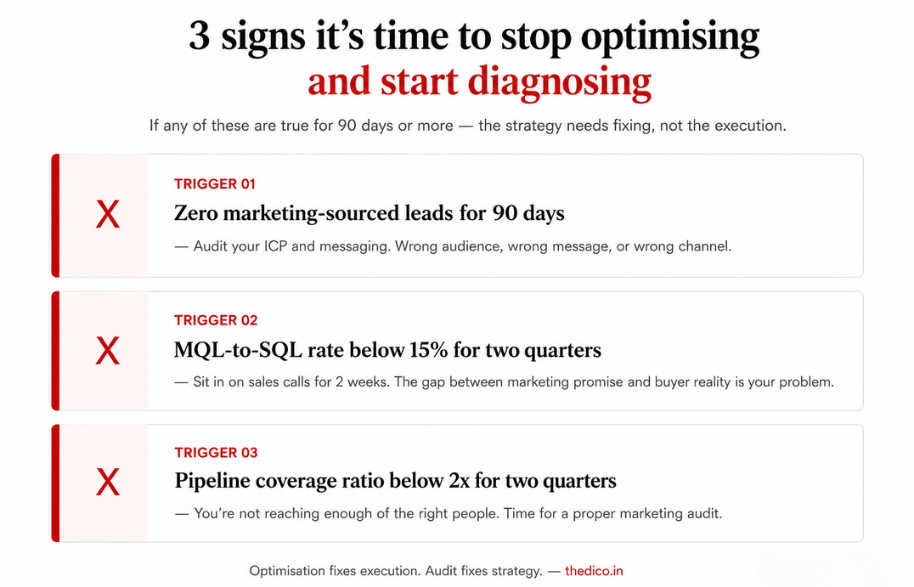
Optimisation is not always the answer. Sometimes the strategy itself is wrong, and no amount of better execution will fix it. Here are three concrete triggers — if any of these are true for 90 days or more, stop optimising and start diagnosing:
- If this is true: zero marketing-sourced leads for 90 days. The signal: your marketing is generating activity but no pipeline. Channels are running. Nothing is producing conversations. What to do: audit your ICP and messaging first, then audit your channels. The problem is usually one of three things: wrong audience, wrong message, or wrong channel for this audience.
- If this is true: your MQL-to-SQL rate is consistently below 15 percent. The signal: marketing is passing leads to sales but sales is rejecting most of them. The pipeline looks busy but very little is converting. What to do: sit in on sales calls for two weeks, listen to the objections, then compare them to what your marketing content is promising. The gap between the two is your problem.
- If this is true: your pipeline coverage ratio has been below 2x for two consecutive quarters. The signal: you do not have enough qualified opportunities in the pipeline to hit revenue targets. Marketing is not filling the gap left by referrals. What to do: this is an ICP and channel problem. You are either not reaching enough of the right people, or you are reaching them with the wrong offer. A proper marketing audit will surface which.
What Good Marketing Measurement Looks Like in Practice
When a B2B company has its measurement right, the Monday pipeline meeting looks different. The sales head can say where the last three enquiries came from. The founder can look at four numbers — not forty — and know whether the direction is right. Marketing and sales are reviewing the same data and asking the same questions.
It does not require expensive tools. It requires agreement on what to measure, a habit of asking 'where did this lead come from,' and the discipline to track it consistently. At TheDIco, when we run a Growth Audit, one of the first things we map is the source of every deal closed in the past 12 months. For most B2B companies we work with — IT services, manufacturing, HR consultancies — the picture is the same: referral-heavy, channel-light, no system for understanding which marketing activity is doing any work. That is what the audit surfaces. Learn more about our approach at thedico.in/audit-strategy/.
If you want to understand what a marketing audit actually uncovers before you consider one, read our earlier piece: What Does a Marketing Audit Actually Reveal About Your Business?
Your Marketing Health Check — 8 Signs It Is Time to Diagnose
- You cannot name a single lead in the last 90 days that came from a marketing channel
- Your sales team builds its own materials because marketing's content does not match what buyers actually ask
- Every deal in the last year started with a referral or a personal introduction from the founder
- Your marketing reports show traffic and impressions but no data on enquiries or pipeline
- You are spending on marketing monthly but cannot connect that spend to a single sales conversation
- Your website traffic is growing but your enquiry volume is flat or declining
- Marketing and sales use different definitions of a 'qualified lead' and rarely agree on quality
- Your pipeline coverage ratio has been below 2x for more than one quarter
Frequently Asked Questions
How do I know if my marketing strategy is working?
Your marketing strategy is working when it produces a traceable outcome — a lead that found you through a channel, a prospect who came in already informed, a conversion you can point to. The simplest test: ask your last five new leads how they found you. If none mention a marketing channel, your strategy is not yet producing results. At TheDIco, this is one of the first diagnostic questions in a Growth Audit — and the answer alone usually tells us most of what we need to know.
What B2B marketing metrics should an Indian company actually track?
Start with four: new enquiries per month, lead source for each enquiry, enquiry-to-meeting conversion rate, and pipeline coverage ratio. These four numbers give you a complete picture of whether marketing is producing pipeline — without needing a CRM, a data team, or a complex dashboard. Once you can track these consistently for 90 days, layer in CAC and MQL-to-SQL conversion rate. Most Indian B2B companies at the growth stage are trying to track twenty metrics and getting accurate data on none of them.
What is a pipeline coverage ratio and why does it matter?
Pipeline coverage ratio is the total value of your active qualified pipeline divided by your monthly revenue target. A healthy B2B pipeline typically runs at 3x or more — meaning if your monthly target is Rs 50 lakhs, you want at least Rs 1.5 crore in active opportunities. Below 2x is a warning sign. Below 1x means you almost certainly will not hit your number 90 days from now. Most Indian B2B founders do not track this — which is why revenue shortfalls feel like surprises when they were always visible in the pipeline data.
What is the difference between vanity metrics and revenue metrics in B2B?
Vanity metrics — website traffic, social followers, email open rates, impressions — measure activity. They can grow without any impact on your pipeline. Revenue metrics measure movement toward a deal: new enquiries, lead source, enquiry conversion rate, pipeline value, and cost per conversation. The problem is not that vanity metrics are useless — it is that they are easy to improve without improving your business. A founder who optimises for impressions instead of pipeline is making a very expensive mistake that will not show up until the next quarter's numbers come in.
How long does it take for B2B marketing to show results?
Paid channels with the right targeting and offer can generate conversations within 30 days. Content and SEO typically take three to six months to show traction. Brand building works on a 12-plus-month horizon. The mistake most founders make is applying the same timeline expectation to all three. At TheDIco, companies that complete a 30-day audit and build the right foundations first typically see their first attributable marketing-sourced leads within 60 to 90 days. Without the diagnostic work first, you are optimising blind.
Can a fractional CMO help me build a marketing measurement system?
Yes — and this is often the most immediate value a fractional CMO brings. Before strategy, before campaigns, before hiring. A good fractional CMO will define what to measure, build the simplest possible tracking system for your stage, and establish a shared definition of a qualified lead between marketing and sales. Maran at TheDIco does exactly this in the first 30 days of every engagement — because without measurement clarity, any strategy you build is based on guesswork.
Your pipeline knows if your marketing is working. Let's find out what it's saying.
If three or more of those signals felt familiar, you do not need more marketing activity. You need a diagnosis. TheDIco's 30-day Growth Audit maps exactly what is working, what is not, and what to fix first — so your next rupee goes in the right direction.
Book a free call: thedico.in/contact-us/ | consultmaran@gmail.com
Filed under
- Measurement
- Pipeline
- Sales and marketing alignment