A great product earns a place in the market. Marketing determines whether buyers discover it in the first place. Many established businesses struggle with growth not because of product quality, but because potential buyers cannot easily find, understand or differentiate them from competitors. Strategic marketing for great products bridges that gap by improving visibility, positioning and credibility.
There is a belief that runs deep in Indian business, particularly among founders who have built their companies through hard work and genuine craftsmanship: if the product is good enough, the market will find it.
TheDIco has worked with founders who have wondered, "Our product is better than theirs. We know it. Our customers know it. So why are they growing faster?"
The assumption is usually that the market rewards the best product. The reality is less comfortable.
The market doesn't reward the best product. It rewards the product buyers understand, remember, and trust.
Why Founders Resist This Truth
The resistance comes from a few genuine places.
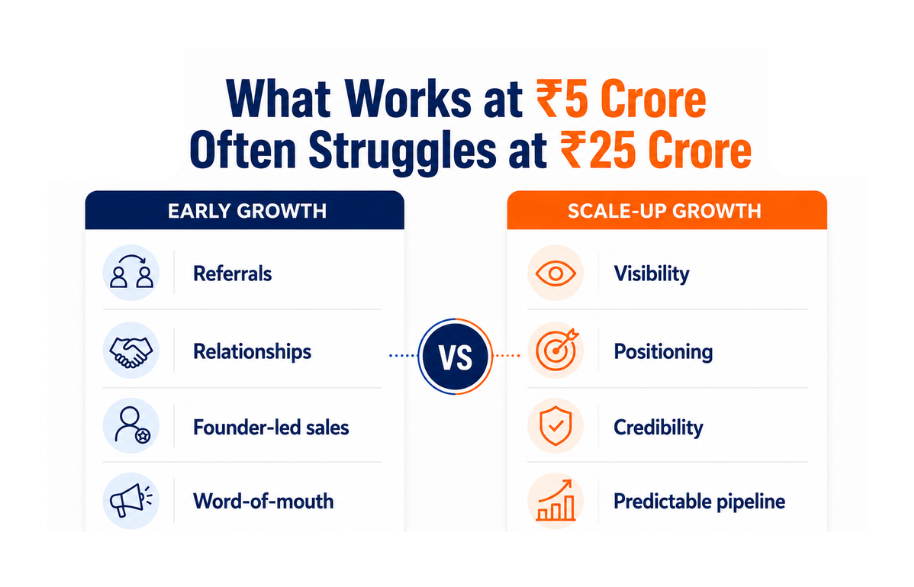
First, many founders built their early businesses on referrals and relationships. The product was good, word spread, and revenue grew. Marketing felt unnecessary because growth happened without it. What they missed was that those referrals were a form of marketing. Someone was advocating for the product. The pipeline was just informal.
Second, there is a cultural distrust of marketing as a function. Marketing is perceived as spin, as persuasion without substance, as the domain of people who talk more than they deliver. Founders who built their businesses on technical excellence often see marketing as the opposite of what they stand for.
Third, and most importantly, many founders confuse marketing with advertising. They tried a campaign, but it did not deliver, and they concluded that marketing does not work for their kind of business. What they actually discovered is that advertising without a strategy does not work. That is different.
None of these beliefs become a problem when a business is small. In fact, they help founders stay focused on quality and customer satisfaction. The challenge begins when growth slows down. Referrals become inconsistent. New customer acquisitions become harder. Competitors become more visible.
What worked for ₹5 Crore often struggles at ₹25 Crore. At this point, marketing stops being a promotional activity and becomes a growth function.
A Real Example: When the Product Was Never the Issue
A mid-sized industrial automation company in Coimbatore had spent fifteen years building one of the most reliable PLCs in its category. Repeat business was strong. But new client acquisition had barely moved in three years.
Most founders would have considered this a sales issue. It isn't. When TheDIco team examined their situation, the product was excellent. But the company's strongest advantages like product reliability, after-sales support and fifteen years of experience were virtually invisible during the buyer's decision-making process.
Competitors with less capable products were consistently appearing in industry conversations, search results and webinars. The company wasn't losing because of the product. They were invisible at the moment their buyers were forming shortlists.
The challenge was positioning, visibility and the absence of a strategy to help buyers understand why the company deserved consideration in the first place.
To address this, TheDIco helped the company clarify its positioning, build credibility through industry-relevant content, and become visible in places where buyers were actively researching solutions.
Within a year, inbound enquiries from new clients had increased by over 60%, and the conversion rate on those enquiries was higher than anything their sales team had seen before. The buyers who reached out already understood the company's capabilities, track record and strength. The sales conversation no longer started with explaining who they were. It started from a position of credibility and trust.
Nothing about the product changed. The market's ability to discover it did.
The IT Sector Is Not Exempt
This is not a problem unique to manufacturing. Indian IT services companies face a version of this challenge every day.
The IT services landscape is extraordinarily competitive. There are thousands of companies offering similar capabilities: custom development, product engineering, digital transformation, and managed services. When a potential client is evaluating five IT partners with similar service offerings, they are not comparing code quality. They are comparing credibility, expertise, industry understanding and perceived risk.
This is why a ₹15 crore IT services company finds itself competing with firms several times its size. The question is whether buyers have enough confidence in your business to include you in the conversation. A company that grows is the one that makes it easiest for the buyers to understand who they help, what problems they solve, and why they are different.
This is not a flaw in the market. It is how markets work. The question then becomes: if a great product is not enough, where should an established business focus first?
Where Established Businesses Should Start
The question TheDIco team hears from most founders at this stage is a practical one: where should I start?
The answer depends on understanding what is actually limiting growth. For some businesses, the issue is visibility. For others, it is positioning. For many, it is a lack of clarity around who they are trying to reach in the first place.
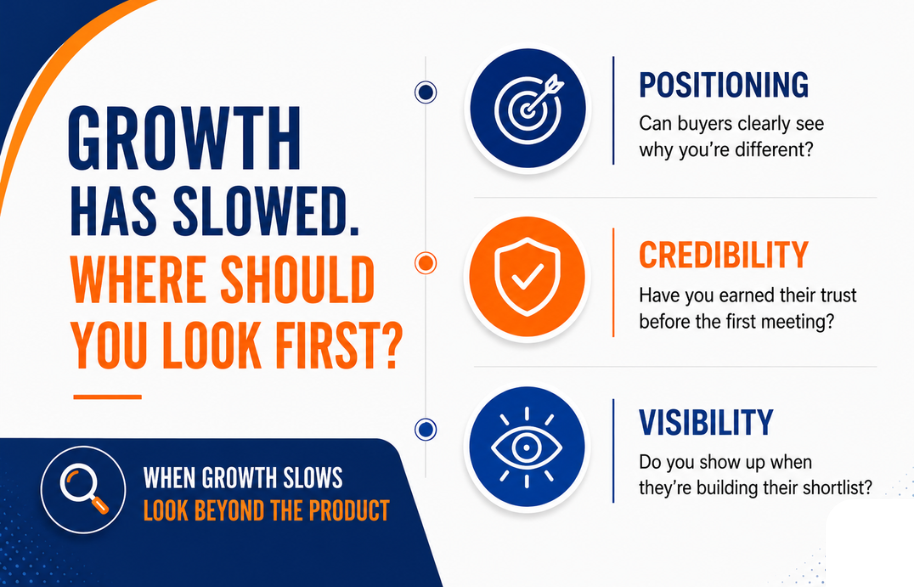
There are three areas where established B2B businesses most commonly leave value on the table:
- Positioning. Most companies cannot clearly articulate why a buyer should choose them over a specific competitor for a specific use case. Generic claims about quality, experience, and customer service are not positioning. They are noise. Real positioning is specific, defensible, and built around what your ideal buyer actually cares about.
- Credibility. Buyers do not trust companies that only talk about themselves. They trust companies that demonstrate expertise. Case studies, technical articles, and insights that genuinely help buyers make better decisions build the kind of credibility that converts.
- Presence at the moment of consideration. Whether that is search, LinkedIn, industry publications, or trade channels, you need to be visible where your buyers are looking when they are actively evaluating options.
None of this requires a large marketing team or an outsized budget. It requires clarity, consistency, and the willingness to treat marketing as a strategic function rather than an afterthought.
Wondering what this would look like for your business?
Book a free 30-minute call with Maran
The Cost of Waiting
The most expensive assumption most established businesses make is believing that they can address marketing later.
While you are waiting the buyers are still researching, comparing alternatives, and building shortlists. If your business is not visible during the process, someone else is.
The cost shows up as slow growth, fewer qualified opportunities, increased dependence on referrals, and competitors becoming better known in the market despite offering a similar, or sometimes weaker product.
For businesses who have spent years building genuine expertise, the challenge is ensuring that capability is visible and known by people making buying decisions.
The longer the gap, the harder it becomes to close.
Final Thought
A great product is the foundation. It is non-negotiable. Without it, marketing is just noise with a short shelf life.
But a great product without strategic marketing is a business that is permanently underperforming its potential. It is revenue left uncaptured, relationships never formed, and markets never fully entered.
The founders who understand this, who treat marketing with the same rigour and investment they give to operations, quality, and product development, are the ones building businesses that last.
The question is not whether your product is good enough. It probably is. The question is whether the market knows it before they choose someone else.
If your business has strong fundamentals but your marketing is not reflecting that strength in the market, it is worth having an honest conversation about why. Book a discovery call with Maran at thedico.in/contact-us
FAQs
Why is my competitor winning deals even though our product is clearly better?
Because your buyer does not know that yet. Before any conversation happens, they are already forming a shortlist based on what they find online — your website, your content, your case studies, how clearly you articulate the problem you solve. If your competitor shows up there and you do not, they win.
How long does it take for marketing to actually show results for a B2B company?
Typically six to twelve months for meaningful, compounding results — but you should see leading indicators much earlier. Enquiry quality improves. The right conversations start happening. Buyers arrive already knowing who you are. The mistake many founders make is judging marketing by advertising timelines. Maran's approach sets measurable leading indicators from month one, so you are never waiting in the dark.
We tried digital marketing before and it did not work. What would be different this time?
Because last time, you ran channels without strategy. Ads and SEO without clear positioning is money spent amplifying confusion. The sequence matters: first, get sharp on who your buyer is, what they care about, and why you are the right choice for them specifically. TheDIco starts there, before touching any channel. That foundation is what makes execution actually work.
Do I need a big marketing budget to see results as a B2B company?
Not at the stage most founders assume. A budget without clarity is wasted fast — and clarity is free. The first investment is strategic: getting your positioning right, identifying where your buyers actually research, and building content that earns credibility. TheDIco's work with established businesses consistently shows that focused, well-directed marketing on a disciplined budget outperforms scattered spend at three times the size.
Should a manufacturing or IT company invest in content marketing?
Yes — but not the generic kind. Content works when it addresses the specific questions your buyers are asking during their research phase. For a manufacturer, that might be technical comparison guides or application case studies. For an IT firm, it is demonstrating expertise on problems your buyers are actively trying to solve. TheDIco helps businesses identify exactly which content moves buyers from awareness to consideration, and builds from there.
Filed under
- Positioning
- Messaging
- Demand