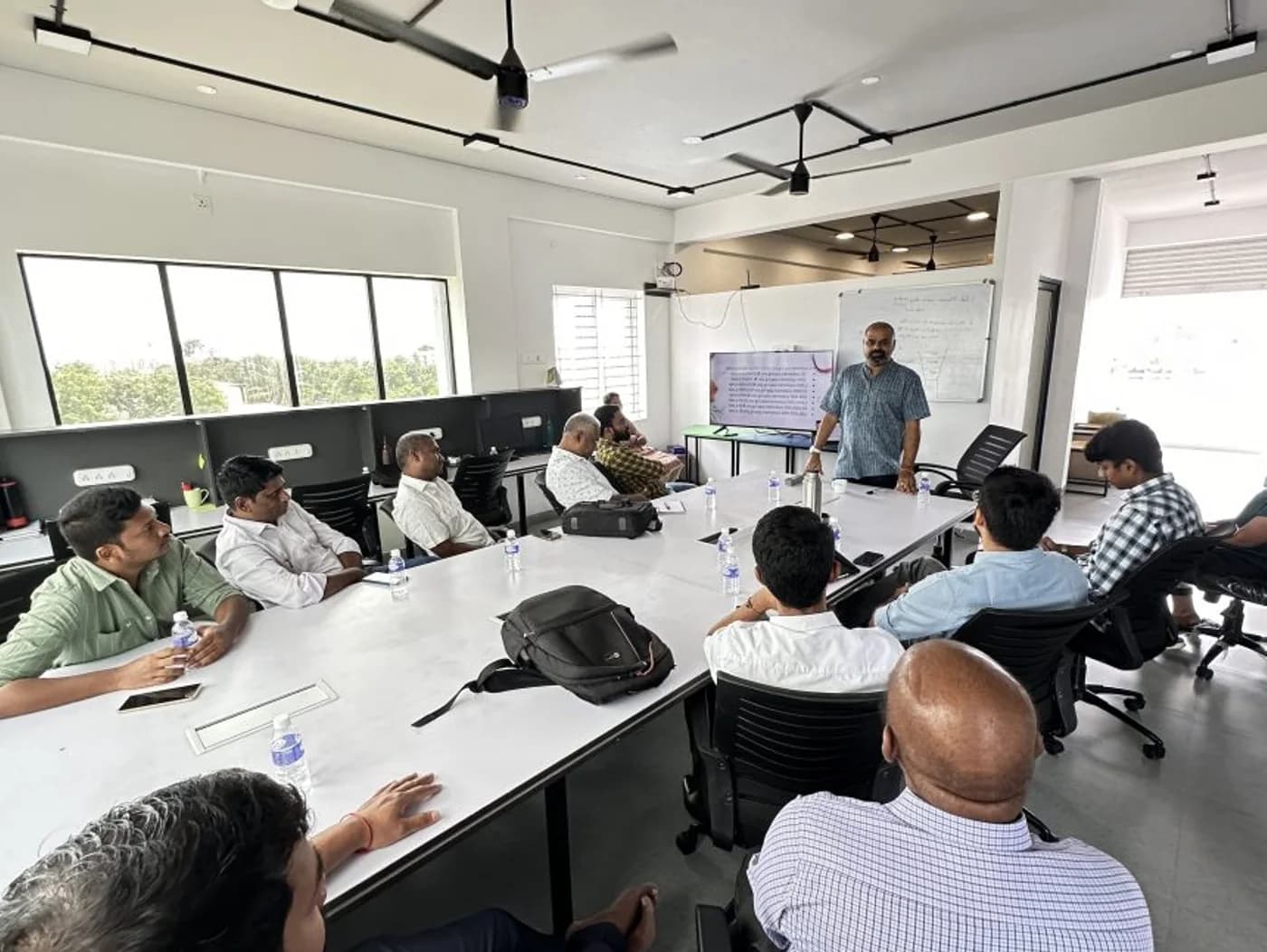
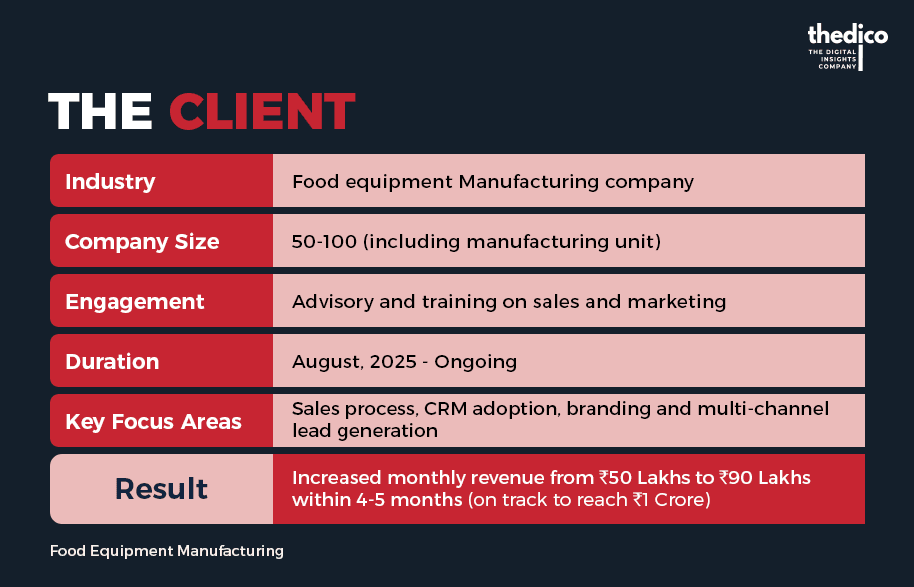
This case study is about a food equipment manufacturer in Coimbatore. It runs its own manufacturing unit, with a team of 50-100 people. The products were good, and enquiries came in every week. The problem started after a lead arrived. The team had no fixed way to follow up, qualify, or close it.
We worked with the team for 4 to 5 months. We set up a clear sales plan, a fixed sales process, a CRM, and weekly reviews. In that time, the client’s monthly closures moved from ₹50 lakh to ₹90 lakh.
The Problem
Plenty of Leads, Few Orders
The manufacturing company made high-quality products and received enquiries every week. But the sales did not grow at the same pace, and many leads were lost before they turned into orders due to the lack of a clear path from qualification to closure.
The Initial Metrics
- Monthly closures were around ₹50 lakh
- There was no fixed sales process; every salesperson worked differently
- Lack of a tracking tool: who was called, who needed a follow-up, and who was ready to buy
- Good leads were lost, and no one could say why
- The brand looked weaker than the products
The problem wasn’t the number of leads; it was what happened after the lead arrived. The team needed a clear process and a tool to track every lead. They also needed a strong branding strategy.
The key goals were to build one sales process that the whole team follows, track every lead in one place, turn more leads into orders, and establish a strong brand presence.
Our Approach
Process First, Then More Leads
More leads will not help if nothing is in place when they arrive. So we worked in a fixed order: strategy and process first, then the team, then the tools, then a weekly routine, and only then new lead channels.
1. Set the Strategy and Process
We started with a sales and marketing strategy, then built a fixed process around it. The process covered how to qualify a lead, handle the first call, follow up, and move a buyer toward a decision. We wrote down every step so every salesperson followed the same flow.
2. Included the Team in the Process
This was the toughest part. For the first three months, it was quite difficult for them to let go of their old habits. We worked closely with them and encouraged small steps. Over time, the team adopted the CRM tool and a few sales processes. Daily stand-up calls and KPI reviews then became a routine.
3. Implemented the CRM
Once the team started adapting to the system, we moved lead management into a CRM. Every lead, every call, and every follow-up now stays in one place. Now, every salesperson can see the latest lead updates, who is ready to move, and why a deal is stuck.
4. Built a Framework for Managers
We built two different frameworks. The sales calling framework gives each call a clear flow, from the first interaction to the next step. The sales manager framework guides managers on what to track and how to coach the team.
5. Added a Weekly Routine
We implemented stand-up calls and weekly KPI reviews as a regular habit. This kept everyone in sync and showed early when a deal or person needed help.
6. Opened New Lead Channels
Once the process was running, we added more ways to generate leads. An ABM outreach SOP helps the team contact chosen companies one by one. LinkedIn and YouTube SOPs make the brand easier to find and trust online. A Google Business Profile gives buyers one more way to find the company.
The Results
More Closures, a Steady Process
Since we started, monthly closures have kept growing, more leads are followed up and tracked, and the brand looks as strong as its products.
Growth Highlights
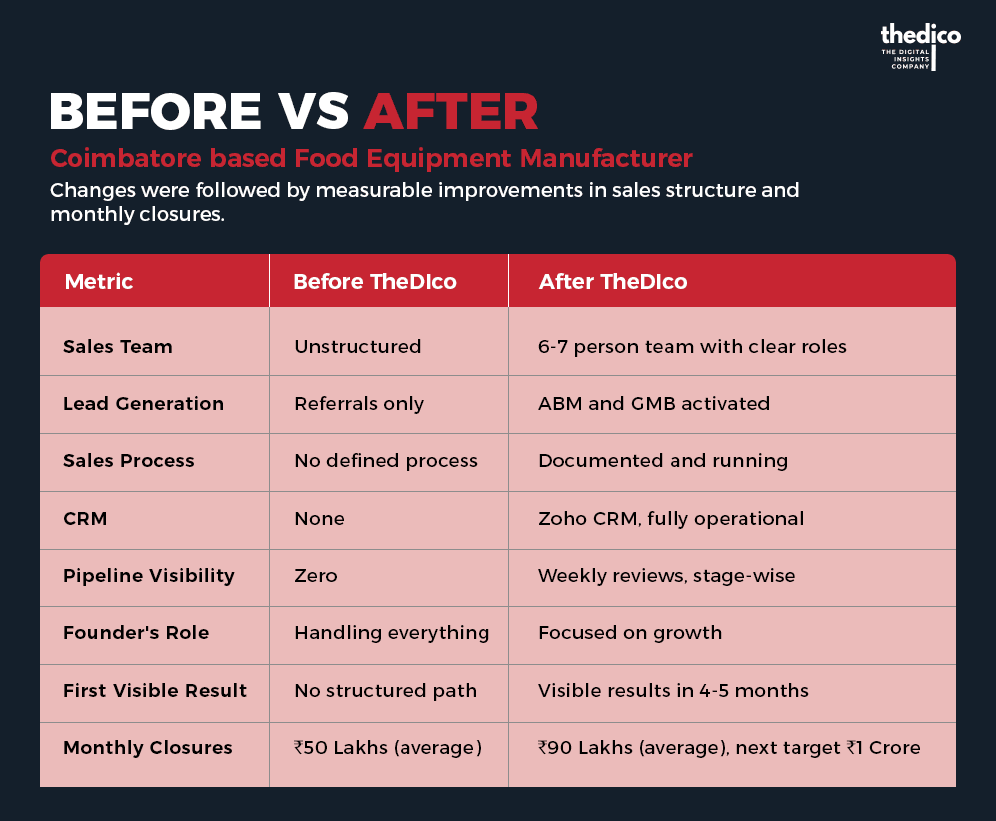
- Monthly closures grew from ₹50 lakh to ₹90 lakh, about 80% higher
- First visible result within 4 to 5 months of starting
- Next target: ₹1 crore in monthly closures
- Every lead now tracked in one CRM
- ABM and Google My Business added as new lead sources
- One sales process, followed by the whole team
- Daily stand-up calls and KPI reviews became a regular habit
By the Numbers
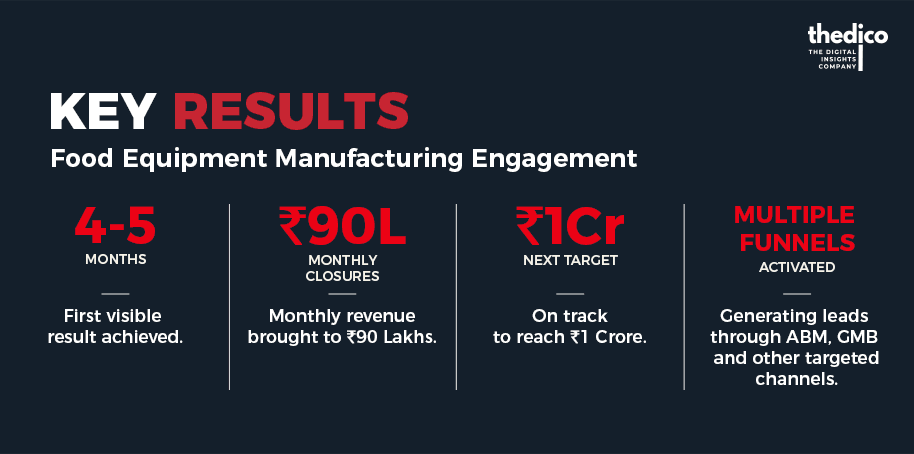
- Monthly closure before the engagement: ₹50 lakh on average
- Monthly closure now: ₹90 lakh on average, about 80% higher
- First visible result: within 4 to 5 months of starting
- Next target: ₹1 crore in monthly closures
- Multiple lead funnels: ABM and Google My Business activated alongside the existing flow
- CRM: in use, with every lead tracked in one place
- Sales process: set, adopted by the team, and now running in a steady way
- Team habits: daily stand-up calls and KPI reviews running as a regular practice
Next Step
If you run a B2B manufacturing business in India and your enquiries aren’t turning into orders, now is the time to start. TheDIco works with companies that make strong products but have no clear sales process behind them. We check where your leads are lost, set up the process and tools to fix it, and train your team to run it.