How fast do you reply to a lead? Your answer should be within 5 minutes for high-intent leads. On average, B2B companies take more than 42 hours to respond. By then, the prospect has already talked to three competitors, forgotten why they reached out, or solved the problem themselves.
A fast reply isn’t enough; your first 10-minute plan will decide whether the lead moves forward. In those first ten minutes, quickly note the source and intent, acknowledge the enquiry, assign an owner, record it in the CRM, and fix one next action. Lead follow-up automation helps you manage these repeated steps so the team can focus on qualifying the lead, understanding buyers’ needs, and building trust.
Key Takeaways
- Make 5 minutes your response time, especially for high-intent leads.
- The lead response time begins from the moment the lead enters your system.
- An auto-generated response is not considered an actual reply.
- B2B companies reply slowly, so a fast lead response time can make you stand out.
What Is Lead Response Time?
Lead response time is the time between a lead entering your system and your team’s first action. For example, a prospect submits a Facebook Lead Ad at 11:12 am, and your salesperson calls at 11:19 am. The lead response time for that first call is seven minutes.
The calculation is simple: lead response time = time of first sales response − time the lead entered your system.
Not every response counts the same. An automatic acknowledgement is not a human conversation. A call attempt that rings without an answer is not the same as speaking to the decision-maker.
How Fast Should You Reply?
One clear target for high-intent leads is to reply within 5 minutes. Lead interest quickly drops, and many studies have proven that. According to a Harvard Business Review study, companies that replied within an hour were about 7x more likely to have a real conversation with a decision-maker than those that replied even an hour later. Data shows 78% of buyers prefer the company that replies first, not the one with the best price.
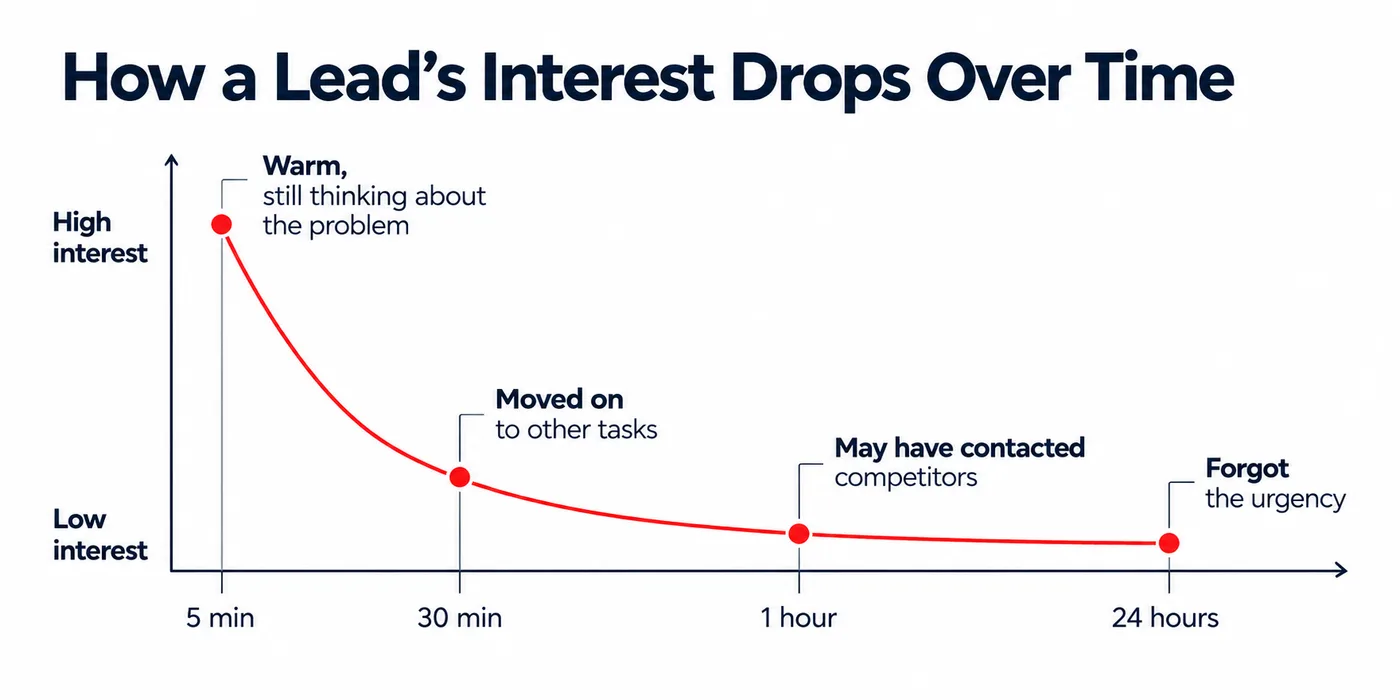
Here is how a lead’s interest usually fades in a steep decay curve:
- At 5 minutes: the lead is warm, still thinking about the problem.
- At 30 minutes: the lead has moved on to other tasks.
- At 1 hour: the lead may have contacted competitors.
- At 24 hours: the lead has often forgotten the actual urgency.
If your team takes 30 minutes or more, you are not a little slow. You are behind most of the market. The good news is that most companies reply slowly, so a faster reply can make you stand out.
Why Lead Response Times Slow Down
Most revenue teams are not slow because their reps don’t care. They are slow because the steps between a form fill and the first call were never built for speed. There are three main reasons why B2B lead response time slows down:
1. Manual lead processing
When leads arrive in a CRM without automatic matching, an admin checks the record, a manager picks the rep, and the rep checks. By then, 30 minutes are gone. Reps spend only about one-third of their time selling, so every minute spent on this work is a minute the lead waits.
2. Every lead gets the same treatment
A demo request and a trade show badge scan from three weeks ago are not the same signal. If your routing process cannot distinguish between them and treats them similarly, time-sensitive leads get stuck behind low-priority ones.
3. Visibility gaps
If you cannot see where a lead is in the handoff process, you cannot fix it. B2B teams often identify lead response time issues only after a deal is lost. Without real-time SLA tracking and reporting, slow handoffs stay invisible until they become costly.
How to Reduce Lead Response Time: First-10-Minutes Plan
Here is the step-wise process to capture, prioritise, assign, contact, track, and nurture incoming leads in the first 10 minutes:
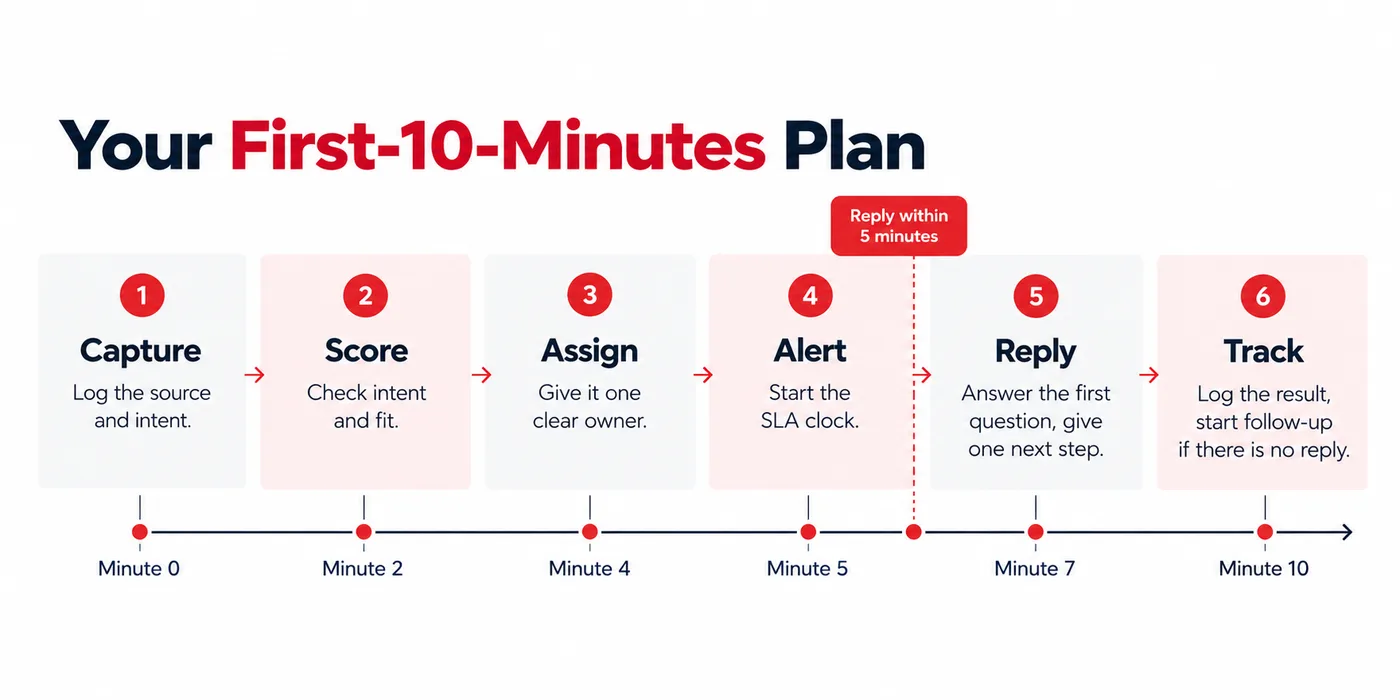
- Capture the lead source and intent: As soon as you receive any leads, log them into the CRM with a creation timestamp and source. You can send web forms, chat conversations, calls, paid lead forms, event leads, and referrals into the CRM for details.
- Score intent and fit: Intent helps you understand the prospect, and fit shows whether the account matches the ICP. Consider using B2B lead scoring to combine both signals and not treat every form fill as sales-ready.
- Give the enquiry a clear owner: Quickly assign the lead to a clear owner depending on the territory, company size, product, industry, language, or round-robin availability.
- Trigger an alert and start the SLA clock: The next step is sending an alert including the prospect’s name, company, enquiry, source, fit data, and the response deadline through the channel the rep monitors, like the CRM, Slack, Teams, email, or a mobile notification.
- Send the first response: Send the first response around the prospect’s enquiry, try answering the immediate question, and provide a clear next step.
- Track and continue follow-up: Depending on the result after the first response, log the lead as contacted, qualified, booked, disqualified, or placed. In case the first attempt fails, move to a defined sales cadence.
Frequently Asked Questions
What is lead response time and why does it matter?
Lead response time is the total time between when a potential customer submits an enquiry and when a sales rep first contacts them. It is important because speed significantly affects lead conversion. Harvard research shows leads contacted within 5 minutes are 9× more likely to convert than those contacted after 1 hour.
What should be automated in the first 10 minutes of a B2B lead?
In the first 10 minutes after a lead is logged, winning teams automate acknowledgement, assign an owner, record the enquiry, and create tasks, reminders, and internal notifications. People should manage the remaining parts: qualification, complex requirements, objections, pricing, and relationship-building.
What is a good lead response time in 2026?
Currently, five minutes is considered a good lead response time for demo, pricing, and callback requests during business hours. Responding within this ideal timeline can put you in the top 7%–23% of B2B teams depending on which benchmark you use.
How can a CRM improve lead response time?
A CRM improves lead response time by automating the whole process, including lead capture, owner assignment, prioritising urgent enquiries, notifying reps, and supporting quick calls or messages. Companies should set up a clear process; otherwise, simply storing the lead in a CRM cannot speed up response times.
Filed under
- Lead response time
- Lead follow-up
- Sales process